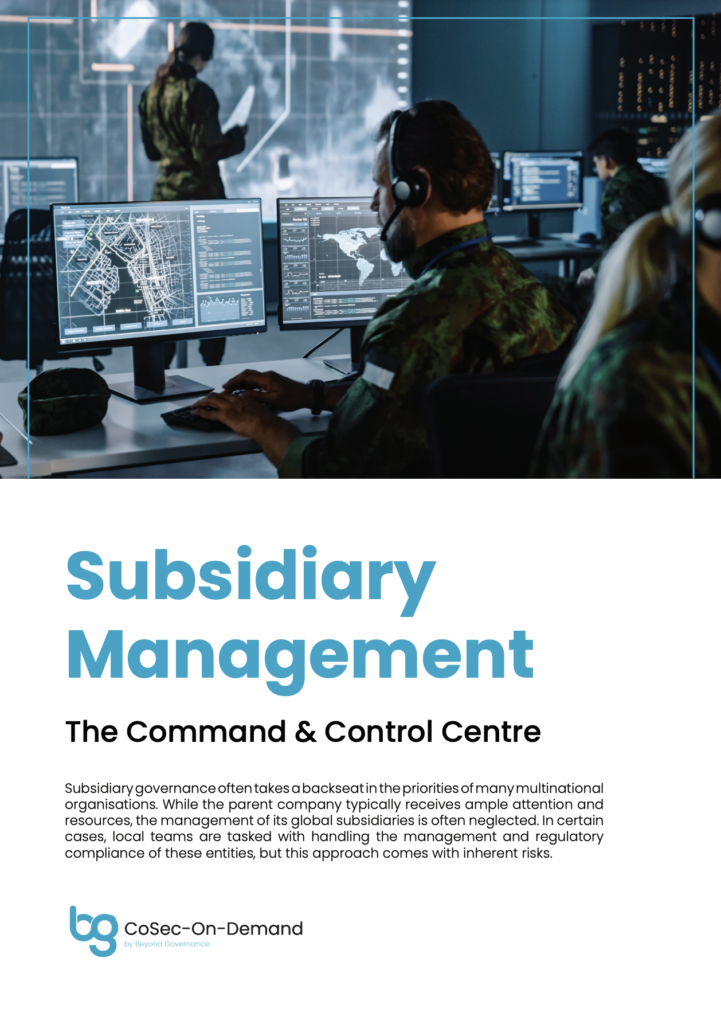

Many organisations with an international presence struggle to oversee and manage risk in their corporate entities (companies, partnerships etc). While many organisations manage these areas well in the parent company or ‘top co.’ few manage those entities below, and even fewer manage those based overseas.
Four Reasons To Address Your Subsidiary Company Skeletons
1) Permanently tarnishing the public record
At its least severe, oversight failures such as late filing of accounts and statutory forms, permanently tarnish the public record of a company. The public record by its very nature is open to the public but more importantly it’s an area of investigation in legal due diligence exercises when a disposal, acquisition, merger or external financing arrangement is sought.
2) Losing your company and its assets
Poor compliance can lead to deregistration of your entity by the local companies registrar. While this may not appear too problematic the process of reinstating overseas entities and reclaiming state owned assets ‘lost’ under bona vacantia (ownerless property, which by law passes to the Crown) can be very convoluted. Reinstating an overseas entity is costly and takes time (sometimes months) and could result in the cost of reinstating the entity being uneconomical.
3) Curbed director’s holiday plans and prison
At its most severe we have worked with companies whose directors have been given a prison sentence due to failings in their role as a director. Additionally, we have had to advise directors not to travel to certain overseas countries on their summer holidays ever again due to the risk of arrest and imprisonment. No one wants to ‘clip the wings’ of your subsidiary directors to travel to certain countries, but it can happen.
4) Fines of US$1m+
Another implication of accounts being filed late can be fines. Whilst in the UK these can add up quickly especially for plc’s:
- Up to a month late = £750.
- Over a month but not more than three months late = £1500.
- More than three months but less than six months = £3000.
- More than six months = £7500.
In other countries these can be exceptionally high. For instance, in a large multi-national company we worked with, accounts hadn’t been filed in an African jurisdiction for ten years which resulted in a fine exceeding US$1 million.
Who takes responsibility for errors?
The Subsidiary Board
In a group structure each entity board has decision making powers and separate legal personality, so responsibility obviously rests with them however the parent company/entity is deemed to be responsible for the overall governance of the group and as such if assets are passing ‘up the group’ it is important that the parent company understand and agree with the policies and practises that are being adhered to further down the group.
The Ultimate Parent Board
In one company we worked for had a UAE subsidiary entity that was not accounting for imports correctly and its parent (another subsidiary) while unhappy with practises let this continue but did not report this up the group. The ultimate parent company board knew nothing about this until the auditors brought it to their attention and by then it was a matter of fraud and the full parent board were embroiled in legal wranglings with the UAE authorities for tax evasion and fraud. The PLC directors were surprised to find that they were equally accountable for the mismanagement of the subsidiary despite having no direct oversight of it. This illustrates the point that subsidiary governance is very important and its integration into the overall governance structure of a group is vital. See diagram below.
Are your subsidiary directors suitable?
Subsidiary directors are often selected from amongst the internal ‘executive pool’ and as such appointments are often made, and seen amongst employees, as a form of recognition for senior individuals. Whatever the rationale the legal, and often the regulatory responsibilities associated with the role of director, are no different for a director of the parent company to one of a subsidiary company, but this is often overlooked. In order to safeguard the ultimate parent company board, you need to ensure the subsidiary directors are discharging their own responsibilities well.
Mitigating risk
If you decide to manage this in-house, you will need to agree some governance principles for your overseas entities and how they will report and provide assurance centrally, so the parent board has comfort that these risks have been mitigated. You also might consider outsourcing the annual audit and annual compliance to an external service provider to free up your time. They will have the resource, expertise and the technology to manage the project.
How we can help
However, you decide to manage your subsidiary governance it is an area not to be overlooked. To help you get started we have produced a handy guide: Subsidiary Governance 101 to help you navigate the key tasks involved in good subsidiary governance.