
Modern organisations are no longer monolithic. Today’s enterprise is an intricate web of parent and subsidiary entities operating across jurisdictions, regulations, and risk environments. While this structure provides flexibility and operational efficiency, it introduces significant complexity for boards, particularly those of the parent company.
For directors, the responsibility no longer stops at the boundaries of the holding company. Stakeholders, regulators, and the public increasingly view parent and subsidiary as a single entity. Accountability, whether fair or not, often rests with the top. The role of directors, therefore, extends well beyond oversight of their immediate organisation; it requires confidence in the governance standards upheld throughout the group.
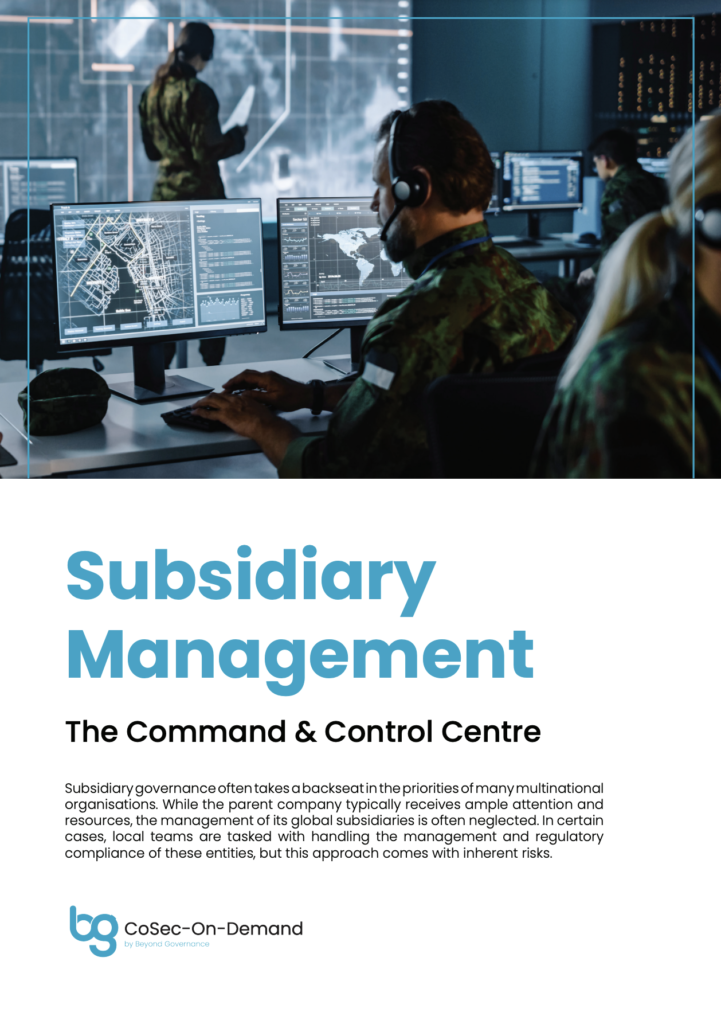
This is where the challenge begins. Subsidiaries, by design, operate semi-autonomously, often responding to distinct commercial, cultural, and regulatory conditions. Governance is shared across multiple boards with overlapping but not identical duties. Subsidiary boards must act in the best interest of their own entity while aligning with group strategy. And parent boards must provide oversight without suffocating independence.
In practice, this creates grey zones:
- When should the parent board intervene?
- What information must flow upwards?
- Who ensures alignment between group strategy and subsidiary execution?
Add to this the risk of litigation, public scrutiny, and rising expectations around board accountability, and it becomes clear: unclear governance frameworks and misaligned oversight can create reputational and legal minefields.
How can directors of parent companies ensure effective governance across subsidiaries, balancing control with autonomy, alignment with agility, and transparency with trust?
A Principles-Led Approach
The answer lies in a deliberate, principles-led approach to group-wide governance, one that’s grounded in visibility, clarity, and collaboration.
Create a culture of transparency and structured escalation.
Subsidiary governance cannot be left to assumption. Parent boards need clear pathways for issue escalation and assurance that subsidiaries are addressing the right issues at the right time. The goal isn’t micro-management, but intelligent visibility.
Clarify dual accountability.
Subsidiary boards must understand and be equipped to navigate their dual responsibilities: safeguarding the subsidiary’s interests while contributing to group success. When conflicts arise, a structured process should exist for surfacing concerns, building the case, and seeking resolution at group level.
Build cross-board alignment.
Cross-directorships where directors serve both boards are valuable conduits for insight, but they must be empowered and prepared. Periodic joint committee sessions (e.g., joint audit or risk meetings) and regular review of subsidiary board minutes are essential tools for shared understanding and oversight.
Formalise the board’s role in subsidiary composition.
It is the parent board’s duty to ensure that subsidiary boards are equipped with the right experience, independence, and governance processes. This includes director capability, board structure, and committee function. Governance cannot be assumed; it must be designed.
Accept that external perception is unified, even if internal structures are not.
Stakeholders increasingly treat parent and subsidiary as one. Directors must ensure their governance processes reflect that reality, particularly in D&O coverage, accountability structures, and public messaging.
For directors, the governance of subsidiaries isn’t a technicality, it’s a board-level risk and responsibility. Effective oversight requires more than policies; it requires judgment, systems, and culture. In an age of global complexity, directors must lead with visibility, alignment, and intentional design.
Because if you don’t have clear sight of your subsidiaries, you don’t have governance at all.
Get in touch to understand more about our subsidiary governance offerings