

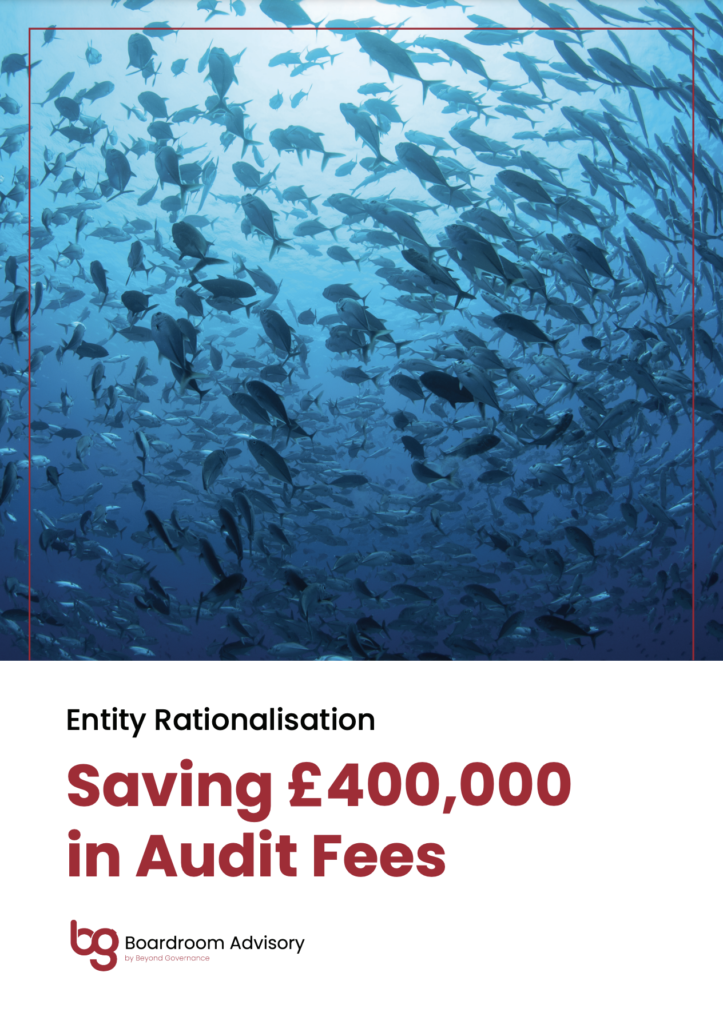
Read a Beyond Governance case study reporting a reduction from approximately 300 group entities to 40, with external subsidiary audit fees falling from £500,000 to £100,000.
Free PDF · 4 pages · Case study
By Beyond Governance
- See the reported change in entity numbers and audit fees
- Understand the work needed before an entity can be removed
- Explore the role of cross-functional review and coordination
Download the audit fees case study
Reviewing the cost of a complex group structure
A group may retain entities that no longer have a clear purpose but still create administrative work and cost. Deciding which can be removed requires a closer look at their obligations and what they still hold.
Entity Rationalisation: Saving £400,000 in Audit Fees describes a review of a group with approximately 300 entities. The case follows the work to identify candidates for removal, resolve barriers and complete the corporate steps. It reports a simpler structure of approximately 40 entities and lower external subsidiary audit fees.
What the case study covers
Identifying entities for review
Understand the starting point and the work needed to establish which entities could be considered for removal.
Resolving outstanding matters
Read about contractual obligations, assets, tax and pension matters that needed attention before the process could progress.
Coordinating the corporate steps
Explore the contribution of different functions and the work involved in carrying out the appropriate dissolution process.
The reported outcome
The source reports external subsidiary audit fees falling from £500,000 to £100,000, a difference of £400,000 in this case.
Who should read it
CFOs, group company secretaries, legal and tax teams, and leaders considering whether a review of the group’s entity structure could reduce unnecessary complexity.
The figures reported in the case
Group entities reduced from approximately 300 to approximately 40. External subsidiary audit fees reduced from £500,000 to £100,000. These are the results reported for this project; the source does not specify an annual savings period.
Why download the case study
It connects the potential value of rationalisation with the detailed work required to achieve it. The account helps explain why identifying an entity for removal is only one stage of the process.
How to use it
Use the case to inform an initial discussion about your own group structure. Consider the information, functions and unresolved matters that a review would need to bring together.
Download the audit fees case study
See how the rationalisation work and reported cost reduction fit together in this case.
Button: Download the audit fees case study
Related resources
Restarting a FTSE 250 Entity Rationalisation Programme
A Guide to Choosing Subsidiary Management Software
Further support
Explore our entity rationalisation support if you are considering a review of your group structure.